September 4, 2026
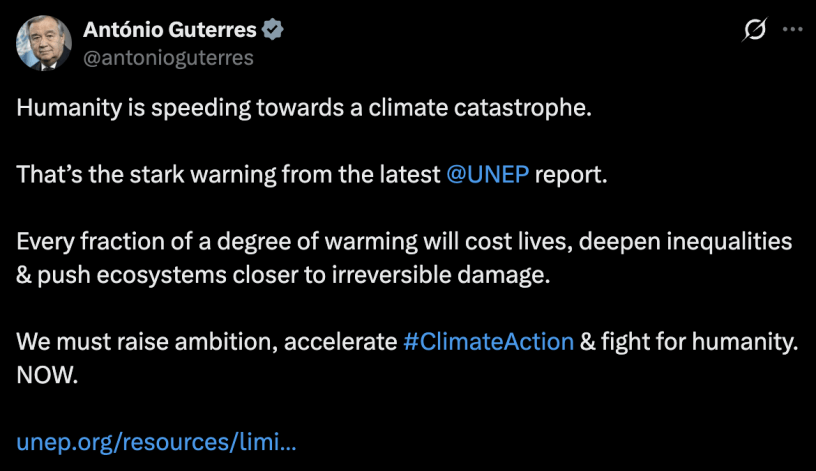
Just two days ago, United Nations released this article. The news labelled it to be a "point past no return", which strikes a chord of fear in anyone keeping up with the climate crisis. Combined with the tweet showed to the right by the Secretary-General of the UN, most responses were ranged from “At least I get to witness the end of the world” to “Nothing’s ever going to get done”. So is it really too late?
The global temperature has risen an average of 1.19 degrees Celsius since 1951 to 1980 on average.
The Paris Agreement (2015) aimed to rectify global warming before it hit 1.5 degrees Celsius. But even without temperature readings, it's clear that this summer has been the hottest and most unstable yet, for people all around the world.
Since August 26, 2026, devastating floods in Nepal and Tibet have destroyed communities and claimed hundreds of thousands of lives. The original cause was theorized to be a mass movement event, with an enormous mound of ice and rock from the Himalayas falling into a river. Mass movement events can be tied to high temperatures, which lead to the melting of permafrost and increased instability of glacial mountains.
Yes, climate catastrophe will happen if we don't pull ourselves together and start trying to solve the environmental impact we've left on the planet. And by no means has climate catastrophe been avoided until now.
Jeffrey Sachs, special advisor to the UN Secretary-General from 2008 to 2018, has recorded a four-part course titled "Globalization: Past and Present" (which I would highly recommend taking). He speaks about the waves of globalization throughout history; specifically, in his final module about the modern age, he tells the viewer that the world, even at the time that he was recording, had more than enough resources to fulfill most of the Sustainable Development Goals. Specifically, one percent of the world's global output could decarbonize fuel sources. Another one percent could end extreme poverty. And one to two percent could provide modern infrastructure to all.
The amount of wealth that is concentrated in countries and individuals, is baffling. We are in no ways lacking funds to solve global issues like the current climate crisis. We are just too divided to put our resources together to make any real progress towards resolving them.
There are real solutions that people have created that will make progress towards reversing the global temperature increase. EARTHDAY.ORG's article on recent innovations lists wildfire-detecting programs, coral reef-feeding devices, and satellite-based images examining deforestation.
It's true that if we continue on the path that we're on now (which, admittedly, seems very likely), we will eventually go past the point of no return. However, as long as there are people who are fighting to stop this downhill fall, there is always a chance that progress can be made. Conceding that it's already too late or there's nothing that can be done means giving up, which guarantees barrelling into permanent ecological devastation.
"The science is clear,” Mr. Guterres [Secretary-General] said. “The solutions are at hand, and the world has never been better equipped to deploy them. Now is the time to raise ambition and accelerate action."
Website Builder Software