What Are We Made Of?
An Analysis of The Vegetarian by Han Kang.
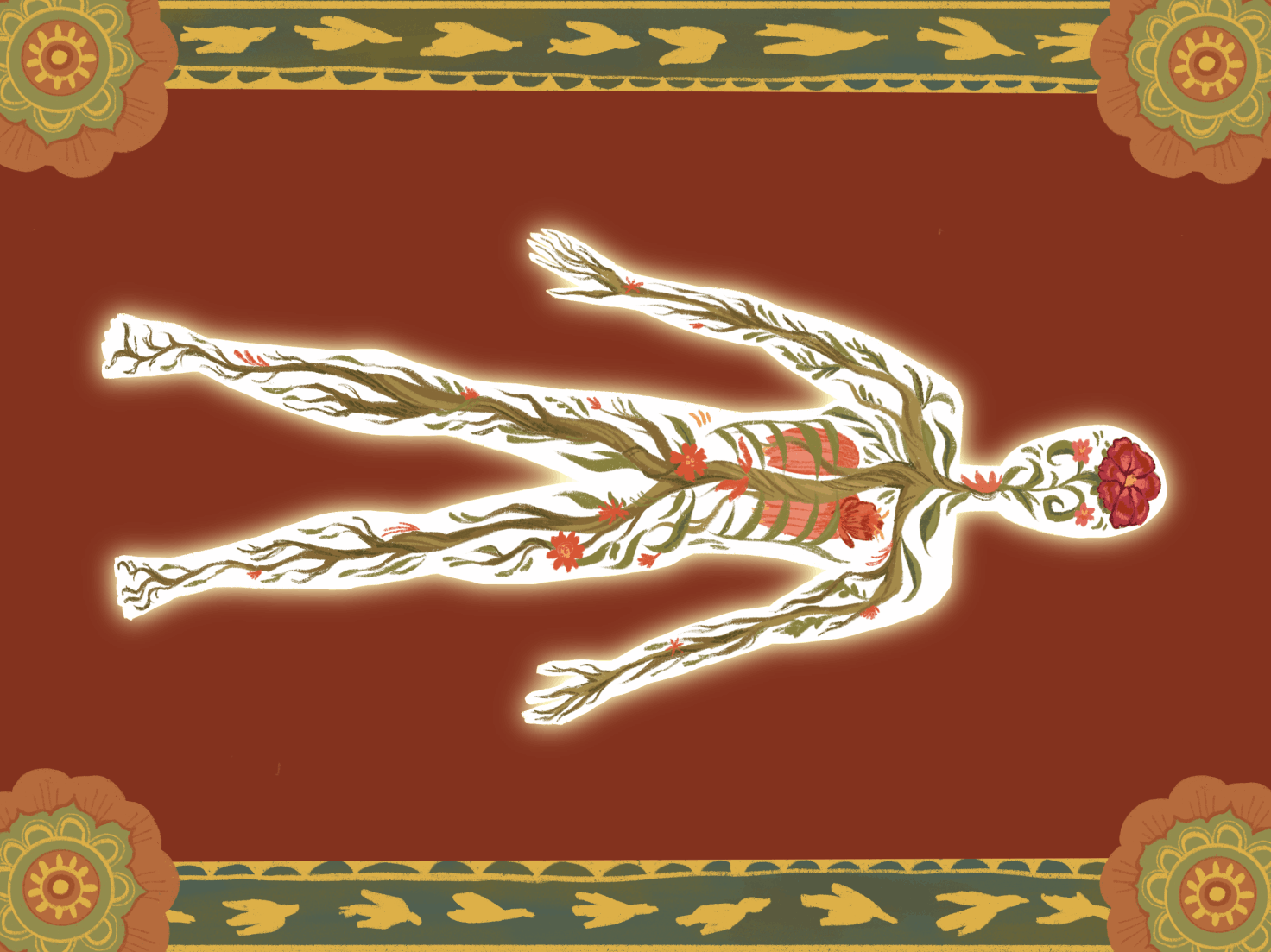
An Analysis of The Vegetarian by Han Kang.
This post discusses topics like mental illness, sexual assault, self-harm, and suicide.
The Vegetarian is a 2007 horror novel by Han Kang featuring the slow downward spiral of Yeong-hye, a woman who suddenly decides to go vegetarian (technically vegan, but who’s counting). Her story is written from the perspective of three characters, all of which being other family members.
The Husband
“In keeping with my expectations, she made for a completely ordinary wife who went about things without any distasteful frivolousness” (14).
The narrator, the husband of the titular vegetarian, had proven to be all types of weird and unlikeable in the first two pages. He comments on his wife’s body, praises her silent and submissive nature, and resigns himself to a mundane life as a businessman with a dull wife and no kids.
And, in the first third of the book, he never once says the name of his wife; the reader has to deduce it from the dialogue of others. Which makes the scene where Yeong-hye rises in a fugue-like state and throws out all the meat in their fridge even stranger.
What’s really going on in The Vegetarian?
Since the 1200s, China has influenced the philosophy, writing structures, and the governing systems of nearby states through tributary ties. Neo-Confucianism – unique to the interpretation of Confucianism after 289 BCE – was the main philosophy of the state, and was restricted to China, Korea, Japan, and partly in Vietnam.
Most East Asian philosophy tends to emphasize communal harmony and common wellbeing. It’s basically a lot of social hierarchies; parents over children, teachers over students, and, traditionally, husbands over wives.
“These ideals [filial piety, family hierarchy, and strong ties between generations] built a collectivist nation, one that emphasizes conformity and ensures that everything is done for the good of the group, not on a single individual” (Beteta 3).
Shirley Beteta’s thesis briefly mentions the role of Confucianism in the mental health crisis in South Korea. Mental illness is typically seen as a mark of shame on family members, and so is rarely discussed. Changes are being made, but social etiquette lags behind.
In The Vegetarian, Yeong-hye is an isolated woman who has moved from living with an unpredictable, abusive father to a dismissive husband. Later on, the husband discusses with his wife’s brother-in-law that he had no hopes of Yeong-hye ever getting better, and essentially abandons her.
This absence allows the next character to step into the story.
The Brother-in-Law
“It’s true, he thought, she really is ordinary. It’s me who’s the crazy one” (79).
A mongolian mark, the title of the second part of the book, is a blue-grey smudge that appears on newborns and usually disappears later on. In In-he’s eyes, Yeong-hye’s mark enhances her innocence and purity because it’s something that literally only appears on very young children.
This third of the book is a harder read because of how scummy the brother-in-law is. He brings fruit to Yeong-hye, and expects his “kindness” to be rewarded. He discourages her from moving on from her self-harm and getting a job in a department store. Every interaction between the two is shrouded with his own attraction for her.
The brother-in-law is self-employed as an artist, eats his wife’s food, and doesn’t take care of his three-year-old son. The husband in the first chapter “envies him”, which tells you all you need to know about the guy.
One of the covers of this novel is the bare shoulder and collarbone of a woman, with red and white flowers painted on. This image references a scene in the brother-in-law’s chapter, where he paints flowers all over Yeong-hye’s body and takes a photoshoot. He justifies it as an “art piece”, but it’s clear what it really is: a fantasy.
One of the facets of South Korea’s gender inequality appears in beauty standards. The notorious idol industry is an extreme example, which this article discusses:
“As seen with images of women entertainment artists, they are held to an unrealistic and at times, inappropriate, beauty standard. Physicality is essential in Korean society, with stigmas against women who may not wear makeup or have short hair” (Tang).
But that’s not all; sexual assault is rarely reported, feminists are viewed as mentally ill, and women in positions of power are few and far in between. The brother-in-law’s chapter serves not just as a reflection of women in South Korean society, but also how the mentally ill are treated afterwards. He takes advantage of Yeong-hye after a traumatic event and strips her further of bodily control.
Yeong-hye’s sister, the brother-in-law's wife, finds a recording of the assault, but doesn’t think once to report her husband. Which brings me to the next chapter.
The Sister
“I have dreams too, you know. Dreams…and I could let myself dissolve into them, let them take me over… but surely the dream isn’t all there is? We have to wake up at some point, don’t we? Because…because then…” (147).
In-hye is Yeong-hye’s older sister and wife of the brother-in-law. During frequent visits to the psychiatric hospital that Yeong-hye is now fully committed in, she blames herself for not protecting Yeong-hye and preventing her from marrying.
In-hye is frustrated and worried for her sister, who has now taken to refusing any food and slowly starving herself. What In-hye eventually realizes is that Yeong-hye goes vegan because she doesn’t want any more violence. Towards her last days, Yeong-hye tells her sister that she wishes to become a tree, to remove herself from the violent and primal actions of humans, like eating or reproduction.
Some towns in Korea have dangsans, trees that are worshipped as guardians of the town and hold a spirit inside. The tree is sacred, treasured, and well cared for, something that Yeong-hye’s body has never felt. Throughout her life, her body has never really been her own. She is force-fed in the psychiatric hospital. She is assaulted by her husband and her brother-in-law. Becoming vegetarian is what Yeong-hye believes will separate her from the dangerous and cruel world of animals.
Even if In-hye also has dreams about a better world or circumstances, dreams that could “take her over”, she knows that it’s impossible to change her situation because of how systemic societal issues are. When Yeong-hye retreats from the world, and tries to separate herself through her diet, In-hye only allows herself to dream once in a while.
The Vegetarian acts as a reflection of the unjust nature of modern society, and a warning to readers. By revealing the slow decline of Yeong-hye and all the instances where the people around her have failed her, Kang encourages the reader, especially women, to support one another and resist traditional values.
Moreover, Kang introduces several binaries: man versus woman, meat versus plant, “ordinary” versus “crazy” (in the brother-in-law’s words). Through the terrifying actions and events during the story, Kang warns the reader that in the right context, anyone can be capable of doing horrible things.
In the end, it all depends on what you believe. So what are you made of?
Beteta, Shirley. “Mental Health Crisis in South Korea.” Wesleyan University, 15 Mat 2020, https://ceas.research.wesleyan.edu/files/2021/02/Shirley-Beteta-Mental-Health-Crisis-in-South-Korea.pdf.
Fishing for Bicycles. “Violence and ‘The Vegetarian.’” Wordpress, https://fishingbicycles.wordpress.com/2017/04/28/violence-and-the-vegetarian/.
Kang, Han. The Vegetarian. Translated by Deborah Smith, Changbi Publishers, 1994.
Tang, Jasmyn J., and Ko Un. “South Korea's Hurdles with Gender Equality.” Human Rights Research Center, 27 February 2024, https://www.humanrightsresearch.org/post/south-korea-s-hurdles-with-gender-equality.
Yeol-gyu, Kim. “당산나무.” Knowledge Encyclopedia, https://terms.naver.com/%ED%95%9C%EA%B5%AD-%EC%97%AD%EC%82%AC-%EB%AC%B8%ED%99%94/%EC%84%9C%EB%82%AD%EB%8B%B9-77LjjyBFH5drdAM5zqvJgq#TABLE_OF_CONTENT5.

AI Website Creator